
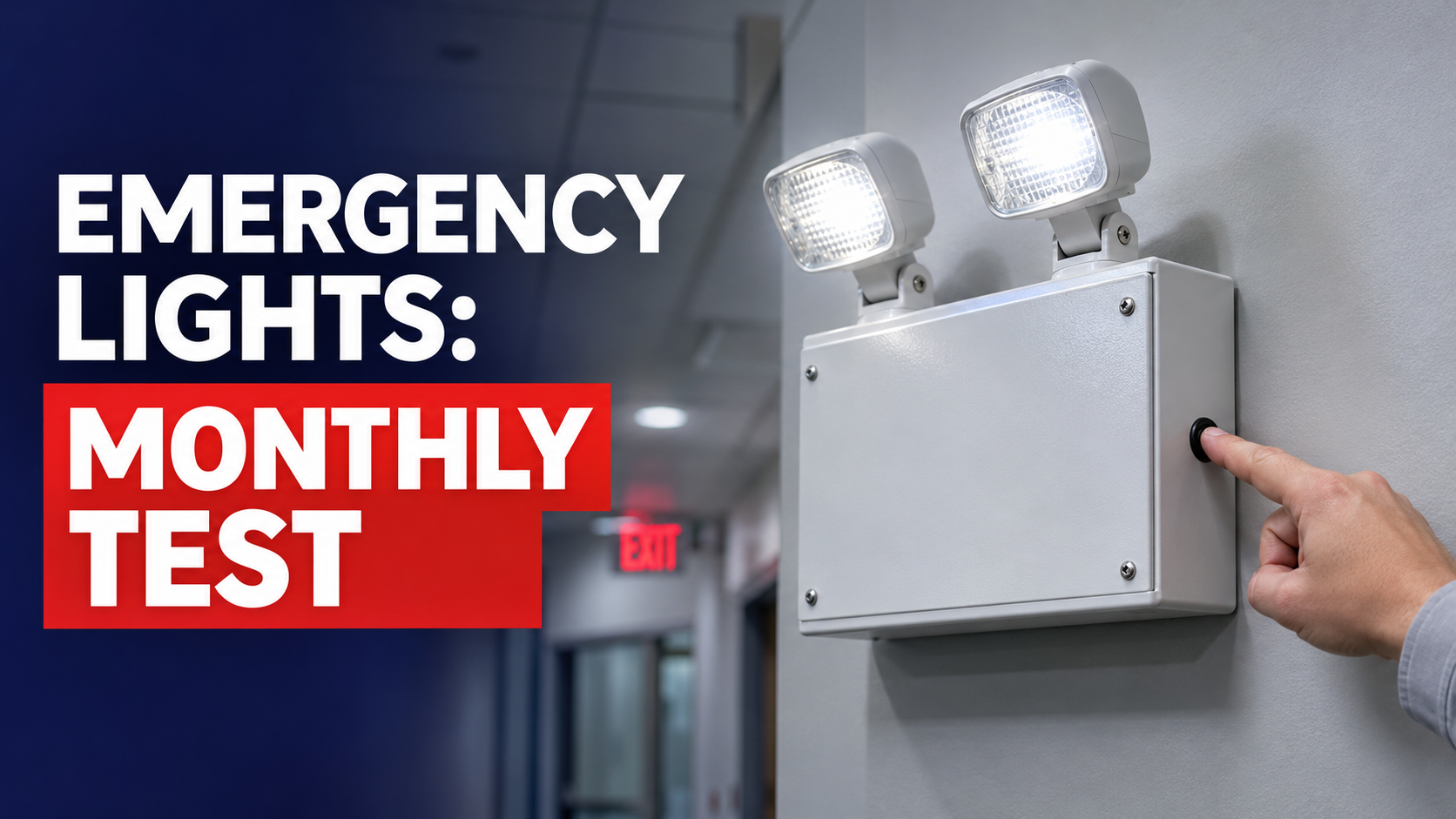
When the power fails, emergency lights and exit signs are what people follow to get out. The fire code asks the building to check them every month, not just once a year.
What the code requires
Article 2.7.3.1 of the National Fire Code of Canada 2020 says exit signs must be lit whenever the building is occupied, and emergency lighting and exit signs must be kept working. Section 6.5 sets the checks:
- Battery emergency lighting units are inspected every month, and tested every month to make sure they come on when the power fails (Article 6.5.1.6).
- Every 12 months, each unit is tested for its full design duration on a simulated power failure, and the charger is checked afterwards.
- Exit signs with battery back-up are checked every month, and for their full duration every 12 months (Article 6.5.1.8).
- Other emergency lights and exit signs are checked every 12 months (Articles 6.5.1.7 and 6.5.1.8).
The monthly check
- Walk the building and check that each battery unit's small pilot light is on.
- Press the test button on each unit and exit sign with a battery. The lights should come on straight away.
- Note anything that stays dark, flickers or has damaged heads.
- Write the date and result in your log.
What the annual visit covers
The technician runs every battery unit for its full rated time on a simulated power failure, then checks that it recharges properly. Units that fail are listed for repair or replacement. Heads are aimed at the exit path, and every exit sign is checked.
Questions
How long is the full-duration test? As long as the unit's design criterion, which is set when the building is designed. The technician tests to that time.
Our signs are LED. Do they still need checking? Yes. The code's checks are about the sign staying visible when the power fails, whatever the lamp type.
Will the lights be off during the test? Only the units being tested switch to battery. Normal lighting stays on.
Book your emergency lighting test online, and your request goes to the member that serves your city.
Call 1-833-344-3473, email service@firecanada.ca or visit www.firecanada.ca.
Source: National Fire Code of Canada 2020, Articles 2.7.3.1 and 6.5.1.6 to 6.5.1.8.